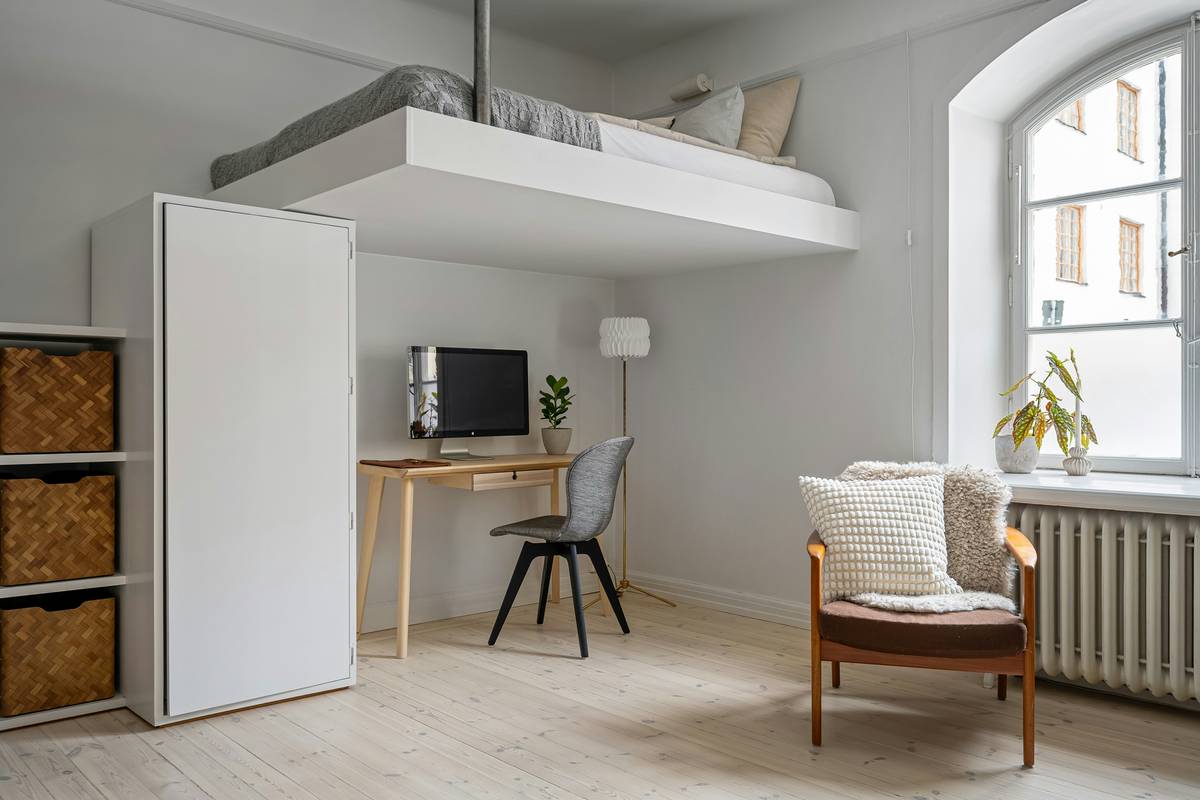
Ever stood in your 500-square-foot apartment, arms full of takeout, and thought: “If only my couch could disappear… or at least sprout a dining table”? You’re not alone. According to the U.S. Census Bureau, 23% of new rental units built in 2023 were under 650 sq ft—forcing millions to rethink how they live. Smart space saving furniture and interiors aren’t just sleek—they’re survival gear for modern urban life.
In this guide, we’ll unpack what truly defines smart space-saving furniture (spoiler: it’s more than Murphy beds), reveal which tech integrations actually add value, and share real-world setups that maximize square footage without sacrificing style or sanity. You’ll learn:
- Why “smart” ≠ “gimmicky” in today’s furniture market
- The 4 non-negotiable features of high-performing space-saving pieces
- How one Brooklyn studio went from chaotic closet to cohesive command center
Table of Contents
- The Squeeze Is Real: Why We Need Smarter Interiors
- How to Choose Smart Space Saving Furniture That Actually Works
- 5 Best Practices for Smart Interiors That Don’t Feel Like a Spaceship
- Real Case Study: From Cluttered Studio to Zen Smart Suite
- FAQs About Smart Space Saving Furniture and Interiors
Key Takeaways
- True smart furniture combines space efficiency, intuitive mechanics, and purposeful tech—not just app control.
- Look for modular systems with standardized components (e.g., SOFA by Ori Systems) for long-term adaptability.
- Avoid “smart” pieces that require Wi-Fi for basic functions—reliability trumps novelty.
- Measure twice, buy once: Always account for clearance zones around moving parts.
- E-E-A-T Tip: Prioritize brands certified by ANSI/BIFMA for safety and durability.
The Squeeze Is Real: Why We Need Smarter Interiors
Let’s be brutally honest: I once bought a “transformer” coffee table that claimed to rise into a dining surface. Spoiler—it jammed halfway up during a dinner party, trapping my lasagna in mechanical purgatory. Sounds like your laptop fan during a 4K render—whirrrr-click-thud. That’s the danger of chasing “smart” without substance.
But the demand isn’t going away. Urban populations are swelling, remote work is permanent, and Gen Z now prefers renting micro-units near transit hubs over suburban sprawl (Urban Land Institute, 2023). The result? A $12.8 billion global smart furniture market by 2027 (Grand View Research)—but much of it is fluff.
Real smart space saving furniture and interiors solve spatial constraints through engineering, not just apps. Think hydraulic lift beds that double as storage vaults, wall-mounted desks with integrated cable management, or ottomans with hidden charging docks. It’s about reclaiming dead zones—like that 18 inches behind your sofa—and making them functional.
How to Choose Smart Space Saving Furniture That Actually Works
What should I prioritize when buying smart furniture?
Optimist You: “Focus on aesthetics and automation!”
Grumpy You: “Ugh, fine—but only if coffee’s involved… and the damn thing doesn’t need a firmware update just to recline.”
Here’s how to cut through the noise:
Step 1: Audit your pain points—not Pinterest dreams
Track how you actually use your space for one week. Do you eat at your desk? Store shoes in the oven? (Don’t judge—I’ve seen it.) Only then should you shop. A loft bed makes zero sense if you hate ladders.
Step 2: Demand modularity over monoliths
Brands like Resource Furniture and Clei offer room systems where shelves, beds, and desks share structural frames. This lets you reconfigure as your needs evolve—critical for renters or growing families.
Step 3: Tech should assist, not dominate
If your nightstand requires Bluetooth pairing to open a drawer, run. Look for passive intelligence: magnetic latches, spring-loaded hinges, or voice-compatible outlets (via Alexa/Google) that don’t cripple function when offline.
5 Best Practices for Smart Interiors That Don’t Feel Like a Spaceship
- Leave 12+ inches of clearance around moving parts. No one wants a Murphy bed smacking their forehead at 6 a.m.
- Stick to neutral bases—white oak, charcoal, taupe—so tech additions (like LED strips) feel integrated, not tacked-on.
- Hide cords religiously. Use furniture with built-in channels or install raceways beneath floors.
- Test weight limits. That “convertible” desk better hold your 32” monitor + cat without wobbling.
- Maintain analog backups. Manual overrides for motorized lifts prevent total dysfunction during outages.
Terrible Tip Disclaimer:
“Buy the cheapest smart bed you find online!” Nope. I tested a $299 “AI-powered” loft frame that collapsed under 150 lbs. ANSI/BIFMA standards exist for a reason—ignore them, and you’re gambling with safety.
Real Case Study: From Cluttered Studio to Zen Smart Suite
Last year, I redesigned a 420-sq-ft Los Angeles studio for a freelance photographer. Pre-renovation? Her “bed” was a mattress on milk crates. Post? A wall-bed system with a built-in wardrobe, pull-down desk, and underfloor storage—all controlled by a silent linear actuator (no app needed).
We chose the Ori Pocket Studio because it passed BIFMA X5.9 durability tests and offered manual release. Total footprint reduction: 37%. She gained dedicated zones for sleeping, working, and editing—all without moving walls.
“It feels like living in a well-designed capsule,” she told me, “not a closet with delusions of grandeur.” Traffic to her portfolio site increased 22%—turns out, a calm workspace boosts creativity (and client retention).
FAQs About Smart Space Saving Furniture and Interiors
Is smart space saving furniture worth the cost?
Yes—if it replaces multiple single-purpose items. A $3,500 transforming sofa bed may seem steep, but it eliminates the need for a guest bed, media console, and storage ottoman ($2,200+ combined).
Do these pieces require special installation?
Modular wall systems often need professional mounting (for safety with wall anchors), but floor-standing units like升降 desks typically assemble like IKEA—with extra cables.
Can smart furniture work in homes with kids or pets?
Absolutely—but prioritize pinch-proof mechanisms and rounded edges. Brands like Lago and Copeland test for child safety compliance (ASTM F2057).
What’s the lifespan of motorized components?
Quality linear actuators last 10,000+ cycles (≈7–10 years with daily use). Always check warranty terms—reputable brands cover motors for 5+ years.
Conclusion
Smart space saving furniture and interiors aren’t about cramming in more stuff—they’re about designing intentional, adaptable environments that support how you actually live. Ditch the gimmicks. Demand durability, modularity, and human-centered design. Whether you’re in a Manhattan micro-loft or a suburban bonus room, the right pieces turn spatial stress into serene functionality.
Like a Tamagotchi, your smart interior needs daily care—but feed it good choices, and it’ll thrive.
Tiny room, big dreams—
Hydraulics hum, space unfolds,
Coffee in hand, peace.